Think about the last website that genuinely impressed you. Chances are it did not just sit there. Something moved, updated, responded, or felt like it knew what you were looking for before you did. That is not a coincidence — it reflects a fundamental shift in how the web is being built. The static webpage, where content was fixed until someone manually changed it, is largely a thing of the past. What has replaced it is something considerably more capable.
Content That Updates Without You Asking
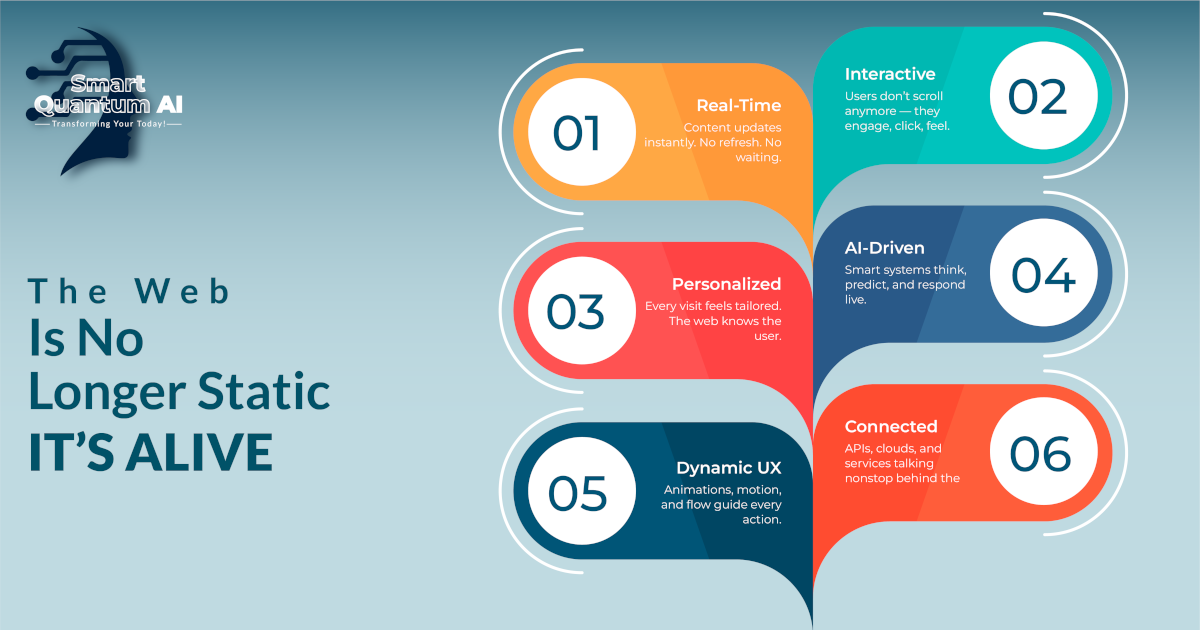
The expectation that a user should refresh a page to see new information feels almost quaint now. Modern web applications push updates in real time — live prices, incoming messages, order statuses, dashboard figures — all changing as the underlying data changes. No reload, no waiting, no stale information presented as current. For businesses where timing matters, this is not a feature. It is a requirement.
Engagement Over Passive Scrolling
The relationship between a user and a website has changed. Scrolling through content is passive; modern web experiences are built around interaction. Users click, drag, respond, configure, and contribute — and the interface responds accordingly. This shift matters because engaged users behave differently from passive ones. They stay longer, convert more reliably, and leave with a clearer sense of what a product or service actually offers.
A Website That Knows Its Visitors
Personalisation on the web has moved well beyond showing a user's name in the corner. The web now adapts — content priorities shift based on what a visitor has viewed before, recommendations adjust based on behaviour, and interfaces reconfigure to match what different users actually need. Every visit to a well-built modern site can feel subtly different depending on who is doing the visiting, and that relevance is what keeps people coming back.
Intelligence Running Underneath
Behind many of these experiences is AI — not as a gimmick, but as infrastructure. Smart systems analyse incoming signals, predict what a user is likely to do next, and adjust the experience accordingly without any manual intervention. A support chat that resolves common queries before they reach a human. A product page that reorders itself based on what similar users purchased. A dashboard that flags an anomaly the moment it appears. These are not future possibilities — they are being built and deployed right now.
Motion With a Purpose
Animation and motion design used to be decorative. In well-designed modern interfaces, they serve a function — guiding attention, communicating state changes, and making transitions feel natural rather than jarring. When done well, a user barely notices the motion consciously, but they feel the difference. The interface becomes easier to navigate because it is actively showing them where to look and what to do next.
Everything Talking to Everything
The modern web does not run in isolation. APIs connect applications to payment processors, logistics systems, CRMs, mapping services, authentication providers, and dozens of other services simultaneously. A single user action on a website can trigger a chain of events across multiple platforms — all resolved in milliseconds. This connected architecture is what makes sophisticated web applications possible at a scale that would have been impractical to build from scratch just a few years ago.
What This Means for Your Business
A website that sits still is falling behind. At Smart Quantum AI, we build web and mobile applications designed around how users actually behave — responsive, connected, and intelligent enough to improve over time. If your current web presence feels more like a brochure than a product, that gap is worth closing.